Whether the setting is a superhero’s version of Hollywood, a medical center/teaching hospital or a suburb positively stuffed with secrets, nobody is more qualified to share the scene behind-the-scenes than the showrunners who oversee these fictionalized universes. Over the two-day WGFestival in June, hosted by the Writers Guild Foundation, several showrunners regaled attendees with accounts of how the writers’ room came together, story arcs and some practical tips about the kinds of skills they look for among the writers they employ. Designed for aspiring and established writers alike, WGFestival advances the Writers Guild Foundation’s mission to create access, connection and opportunities for writers at every stage of their careers.
Written by listened in, picking up some bits of wisdom from the showrunners and writers of The ‘Burbs, Wonder Man, and Scrubs.
“That one person to make you feel safe” – Celeste Hughey, EP and showrunner, The ‘Burbs
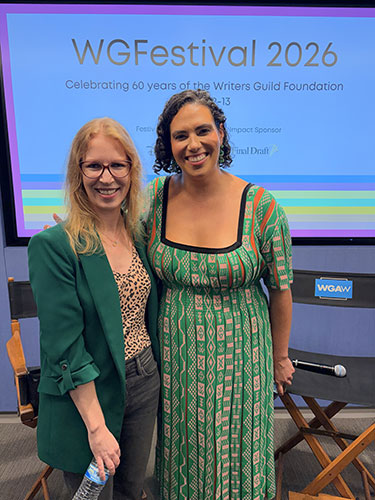 WGFestival moderator Kara Warner with The ‘Burbs creator and executive producer Celeste Hughey. Photo by Writers Guild Foundation.
Following a career as a journalist, WGAW member Celeste Hughey earned her first staffing job on High Fidelity followed by seasons on Dead to Me, and Palm Royale. Her first experience as a creator, EP and showrunner came on the Peacock series The ‘Burbs, a TV spin-off based on the 1989 film The ‘Burbs written by Dana Olsen.
In her conversation with moderator Kara Warner, Hughey credited Dead to Me EP and showrunner Liz Feldman with words of support that, Hughey said, changed her career and her view of herself as a writer. At the time, Hughey was the most junior staff writer surrounded by colleagues who she characterized as “brilliant writers” and too intimidated to offer any ideas of her own.
One day, she went to retrieve a sweater from the writers’ room where she found Feldman having lunch. The showrunner asked how Hughey was doing. In a moment of honesty, Hughey confessed, she was too much in her head and “getting in my own way.”
Feldman assured Hughey that she was in the room because Feldman wanted her there, because she knew she could write and wanted her input. Hughey subsequently pitched an idea that she had previously dismissed as being stupid…only to have it get into the show.
“She was like, ‘That’s not stupid!’” Hughey said. “My script was due that next week, and she called me and said, ‘You understand the tone of this show better than anybody. Find your legs. Find your confidence.’ From that day on, I couldn’t shut up.”
“It’s worth that one person to make you feel safe,” she continued. “I’m so grateful I get to do that for other people now because I’ve been that person. I can tell when someone’s getting quiet or doesn’t feel safe to contribute, and just making it a space where they can and want to, and feel supported is the best part of my job.”
When the subject turned to getting one’s work seen, Hughey recommended having a single great script to use as a calling card.
“A lot of people will have a spec for this, here’s this, here’s that,” Hughey said. “If you have one really great script that’s undeniable and really shows you that your voice is unique, that’s what you truly need.”
Hughey offered a piece of advice to aspiring comedy writers. Make sure that spec script gets readers laughing early. “Those first 10 minutes mean everything,” she said. “If you’re writing a comedy spec, if you don’t have a joke that makes someone laugh in the first three minutes, they’re not reading it. So make sure those first 10 pages really land.”
To assemble a writers’ room for a series that blends elements of different genres, a showrunner needs writers with varying expertise.
“It’s truly like you’re casting a writers’ room,” Hughey said. “It’s people’s experience levels, their backgrounds, their personalities. It’s a puzzle and you want it all to fit together. Some person is the jokes person, some person is the story person. It’s just like creating a little orchestra of people being able to play the same rhythm.”
“They’re all lovely hangs” – Andrew Guest – EP and showrunner, Wonder Man
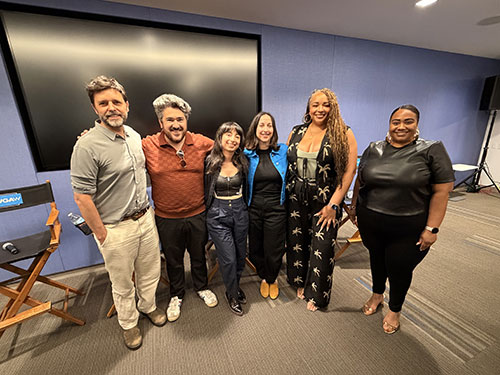 [L-R] EP and showrunner Andrew Guest with Wonder Man writers Anayat Fakhraie, Roja Gashtili, Julia Lehrman, Kira Talise, and WGFestival moderator Brande Victorian. Photo by Writers Guild Foundation.
During his session on the Disney+ Marvel superhero comedy Wonder Man, co-creator, EP, and showrunner Andrew Guest was also asked about assembling his team of writers. What kinds of “superpowers” do the members of his writers’ room need?
“For me, it always starts with the sample. Everybody up here had a brilliant sample,” said Guest, referring to his fellow panelists Anayat Fakhraie, Kira Talise, Roja Gashtili, and Julia Lehrman. “I always encourage people, when they’re thinking about writing, to write the thing that excites you most because that’s what’s going to come through. When you’re in this industry enough, you know what people are looking for, and when you try to write to the needs of the industry, you’re not being true to something that excites you.”
“Every time, it’s a voice that reaches me that I’m like ‘This is unique. They’re doing something I don’t do and that is really cool,’” he continued, “and they’re all lovely hangs. If they can write and you can hang together, that’s what matters most.”

If you have one really great script that’s undeniable and really shows you that your voice is unique, that’s what you truly need.
- Celeste Hughey
Producer and writer Fakhraie harkened back to a round robin conversation with all of the writers at the start of the room. Guest asked each of his writers what had driven them into the craft in the first place.
It felt like an especially topical question given they were about to dive in to a series about a struggling actor with superpowers trying to negotiate the industry.
“The machine of Hollywood is kind of ridiculous, but the dream of wanting to be having your slice of it isn't,” Fakhraie said. “There is a level of arrogance and naivete you have to have if you really want to make this career. You get a lot of rejection. So you need to think at some level like, ‘I’m fucking good at this,’ but also be dumb enough to be like, ‘I don't know how to do anything else.’ You really need to hone that knife.”
“Does this feel like we’re retreading and we’re spec-ing ourselves? Because if it does, we’re throwing that out.” – Aseem Batra, EP and showrunner, Scrubs
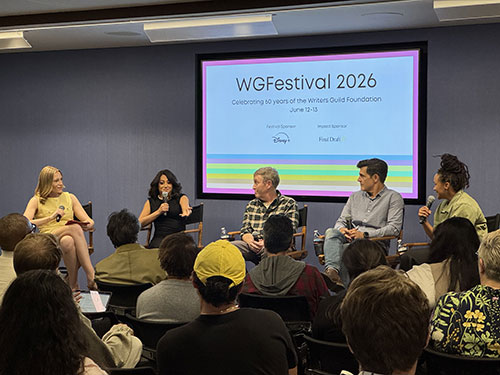 WGFestival moderator Hope Sloop interviews Scrubs EP and showrunner Aseem Batra, EP Mat Harawitz, Co-EP Mark Stegemann, and staff writer Shylo Shaner. Photo by Writers Guild Foundation.
Speaking during WGFestival’s concluding panel, Aseem Batra and several members of her writers’ room discussed the 2026 reboot of Scrubs, 16 years after the conclusion of the series’ nine-season run. Batra first staffed as a staff writer on season 5, and spent seasons 7 and 8 as executive story editor.
The room for the reboot, she said, needed to include both people from the original series as well as new voices. Among the newcomers: staff writer and fellow panelist Shylo Shaner, who also works as a full-time labor and delivery nurse.
“You go out there and you find people who have a voice, like Shylo, somebody who you feel is going to bring something different,” Batra said. “I find that is so exciting that you get somebody who is telling you something completely different than anything you’ve ever heard, and you can bounce off of that whether it’s a job they’ve had or how they identify.”
And how are new writers brought up to speed on the story, tone and voice of long-established characters? According to Batra, writers typically take it upon themselves by watching “more episodes than their eyeballs can handle.”
“That’s the cool thing about writers,” Batra said. “If you can do this job, it’s because you can hear those voices and you can do it on that show, or that show, or that show. It’s just a very cool skill.”
Batra and co-EP Mat Harawitz noted that one of the reasons the rebooted Scrubs nailed its first season is because the series creators looked to tap the spirit of the original, going back to the pilot and the early seasons instead of trying to pick up from where the characters were when the original Scrubs ended.
Batra added that writers worked to strike a balance between newness and nostalgia for a much-beloved series.
“I knew if I’m reading a scene or we’re pitching a scene and it’s starting to feel like a spec of Scrubs—and not a very good spec of Scrubs—we’re in trouble,” Batra said. “I liken the nostalgia to walking into your favorite place when you were a kid. You’re like ‘This is going to be great!’ and you get in there and it’s like, ‘Oh, this is a little bit smaller and a little dusty now,’ and you have to have something else to make that place meaningful, whether it’s showing to your kid or there’s something added to it.”
“So that, for me, that was the barometer,” she added. “Does this feel like we’re retreading and we’re spec-ing ourselves? Because if it does, we’re throwing that out.”