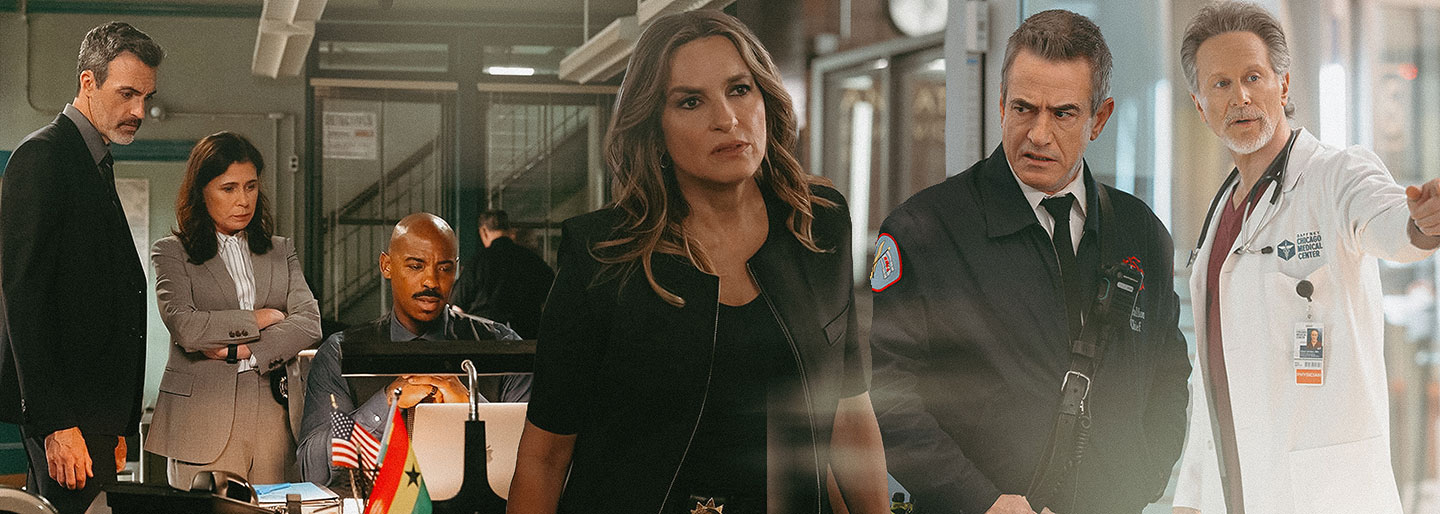
After they have spent years—or in some cases more than a decade—dreaming up crises for protective agencies in the Windy City to face and overcome, one might think that the showrunners and writers of Wolf Entertainment have this particular procedural drill down to a science.
Indeed, the well-oiled Wolf machine that includes Chicago Med (entering its 12th season), Chicago Fire (15th), Chicago P.D. (14th) and the New York-set FBI (9th) and CIA (2nd season) are models of efficiency even as every episode offers fresh mayhem for its characters. The talent and creativity of the series’ writers is a major reason why. During the WGFestival, hosted by the Writers Guild Foundation earlier this summer, the four showrunners overseeing the five writers rooms gathered on Zoom to share the accolades and the challenges that their rooms—both long-running and relatively new—continuously face.
As WGAW members Allen MacDonald, Gwen Sigan, Victor Teran and Mike Weiss hashed out topics ranging from mapping out cliffhangers to reaching the end of Google to new writers penetrating the Wolf Universe radar, Written by took it all in alongside attendees who tuned in from around the world.
Regrouping to Chart Out the Next Season
 Chicago P.D. showrunner Gwen Sigan. Photo by Joseph Puhy.
The gathering of the writers’ room at the start of a new season involves addressing multiple questions big and small. As seasons of these procedurals frequently end in cliffhangers with practical questions left to be answered.
According to Chicago P.D. showrunner Sigan, each new season of the show revolves around a theme. “So we like to brainstorm around that for a while and stay really wide,” she said. “We always do character first—what’s everybody going through, what’s their arc. You’d be surprised how late it is until we actually add crimes.”
For Chicago Med, showrunner MacDonald has a big picture concept for the entire season, but doesn’t immediately know the “signposts” of how the room will get to where they want to go.
“We take a day, and we start pitching medical stories, and generally from there, we start thinking about the first four episodes and breaking them down, assigning writers,” MacDonald said, “and then usually, the writers choose what medical stories they want.”
Teran noted that as he was coming in to run the 15th season of Chicago Fire, the outgoing showrunner left his team with a cliffhanger: a roof collapse and explosion at Firehouse 15. When asked by moderator about the characters’ fates, who would live and who wouldn’t be back Teran confessed “I have no idea.”
Just kidding.
“No, we know. We know by now,” he said. “But we just got into the room and started figuring out the different possibilities. It started in one place, and then as we talked it out, it ended in another place, but it’s going to be big.”
Handling Two Rooms
 FBI and CIA showrunner Mike Weiss.
Shuttling between the rooms of CIA and FBI as the showrunner for both series, Weiss often debriefs with Sigan with whom he previously worked on Chicago P.D. Entering his third season running FBI and his second with CIA, Weiss credited his ability to hire “great writers to work with me.”
“There’s no way to run one show sanely, I don’t think, unless you have an amazing team around you, and with two shows, it’s necessary,” Weiss said. “So I have a lieutenant on each show, who, on a daily basis, might be running the room, or keeping us on track, or running a notes session, or whatever's needed on that day.”
He added that showrunners often overburden themselves, feeling like everything is their responsibility from big picture concerns to coming in with new ideas.
“It can be really overwhelming,” Weiss said, “and so the notion that someone walks in on a Monday and is like, ‘I read a thing, I watched an old movie, I talked to one of our technical advisors, I had a dream, whatever.’ If someone comes in with an amazing idea, we do try hard to, within reason, kind of, grab onto something and say, “Oh, maybe that is better than what we were thinking.”

If you went by fan comments, your two lead actors—if they are a guy and a girl—would be together and having children together, and the audience thinks they want that, but they don’t really want that.
- Mike Weiss
The End of Google
Think you might have a truly original idea for a Chicago Fire storyline? Victor Teran is dubious.
The series will celebrate its 300th episode in the upcoming season. Since characters on the series have tackled close to 700 fire or rescue calls over the course of the series’ 14 seasons, the possibility of a previously unexperienced crisis is unlikely.
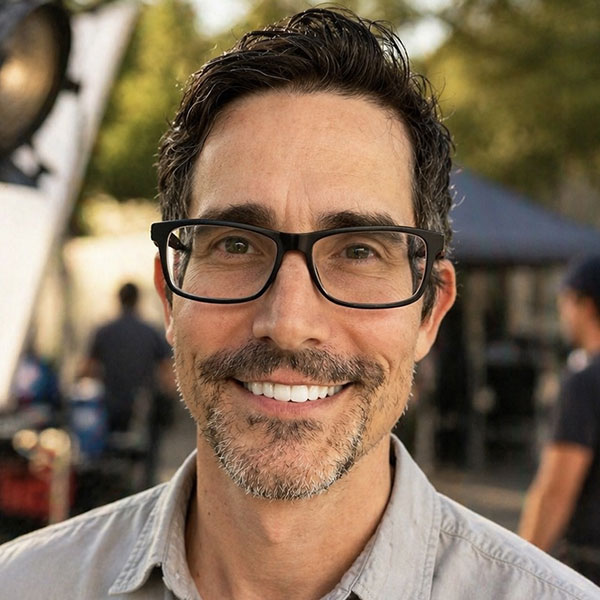 Victor Teran. Photo by Ruby Wendell.
“You do reach the end of Google at a certain point which people probably didn’t think was possible,” Teran said. “We’ve kind of accepted that everything that is possible for the fire department to do, we’ve done it, but there’s always a new way of doing it, or a new set of character circumstances that can play into it, or a new kind of victim. The world does provide. Every week, there is something that just kind of blows our minds, and there’s always video of it which is pretty sick, and sick in a good way.”
Faced with a similar challenge of developing new medical stories after 12 seasons, MacDonald says the writers typically ask whether a particular storyline has been employed in the last five years. And how will it be different in this iteration?
Although narcotics play a role in every season of Chicago P.D., Sigan notes that the trade changes yearly. Between changes in the drugs being manufactured and the fact that the bad guys are getting smarter, fresh angles are always available.
Several of the Wolf procedurals employ professional consultants who serve as technical advisors, but sometimes they are limited in what they can share.
“Oftentimes there will be little things, a detail or a technique. ‘We know the bad guys are in this apartment building, but we don’t know which apartment. What would you do?” Weiss said. Sometimes our technical advisors say, ‘I’m gonna tell you about it, but you can’t put it on TV’ because at a certain point, you don’t want to educate the bad guys about means and methods of the good guys.”
Listening to the Fans
 Chicago Med showrunner Allen MacDonald.
Devotees of long-running procedurals have been known to watch their favorite series through a microscopic lens and to make their feelings—positive and negative—known through social media threads. Do the writers of these shows pay any heed to their fans’ comments? The Wolf showrunners give a qualified yes.
The start of a new season will invariably include a debrief in which the writers go over previous season accomplishments and needs for improvement. What worked, what didn’t, what will they never attempt again? And writers have been known to mention a fan comment from a Reddit thread during these debriefs.
As intelligent as fan feedback might occasionally be, Weiss cited the wisdom of visionary Apple executive Steve Jobs who advocated giving the audience “something they didn’t even know they want.”
“If you went by fan comments, your two lead actors—if they are a guy and a girl—would be together and having children together,” Weiss said. “And the audience thinks they want that, but they don’t really want that. They want to be pleasantly tortured year after year waiting for satisfaction. It’s a tantric creativity.”
“It’s fun to read those things just to know what they’re thinking, but you cannot make any decisions based on it,” added MacDonald. “Because on one Reddit thread, they’ll say how wonderful everything is, and then on the next, they just rip you to shreds. So if you believe the compliments, you also have to believe the criticisms, and I choose not to listen to either.”