In a time so turbulent and politically divided as ours, can fictional public servants in TV shows and film speak truth to power? Can such work effect change? Could a show like Veep or The West Wing be greenlit today? Depends on who you ask.
The now-classic The West Wing (Created by Aaron Sorkin) ran from 1999 to 2006. Rick Cleveland recalls that when he was hired for the first season, “most people expected the show to fail, because they thought it would be about a scandal-ridden president like Clinton. But it was the opposite of that. It was downright Capra-esque, and actually inspired young people to go into politics.”
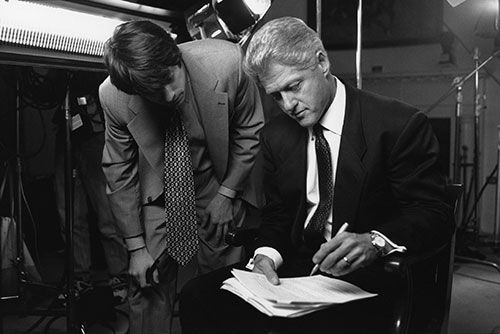 Eli Attie working with President Bill Clinton. Photo by The White House.
Eli Attie went in the opposite direction, from working in the Clinton White House to working on the show. “My time in politics ended with a stolen election, so democracy was under threat even then,” says Attie, who had helped Vice President Gore write his concession speech. “I used to joke that what I did a lot on The West Wing was tell stories from my time in politics and working in the White House, and just changed the last beat of the story to a happy ending.”
Attie now works on The Diplomat (Created by Debora Cahn), which centers on Kate Wyler, U.S. ambassador to the United Kingdom. It’s a grittier show, but it still celebrates hardworking public servants. “If we can make people see, as hard as everything seems, as depressing as the news is, there might just be a few Kate Wylers out there quietly stopping some other war from happening that we never even hear about, then maybe there’s some value to this kind of storytelling.”
Barbara Hall centered diplomacy back when she created Madam Secretary. She also made Secretary of State Elizabeth McCord (and President Dalton) Independents, because “the mission statement was to do a show about politics that wasn’t so polarized and polarizing.” The series ran from 2014 to 2019, spanning two very different administrations.
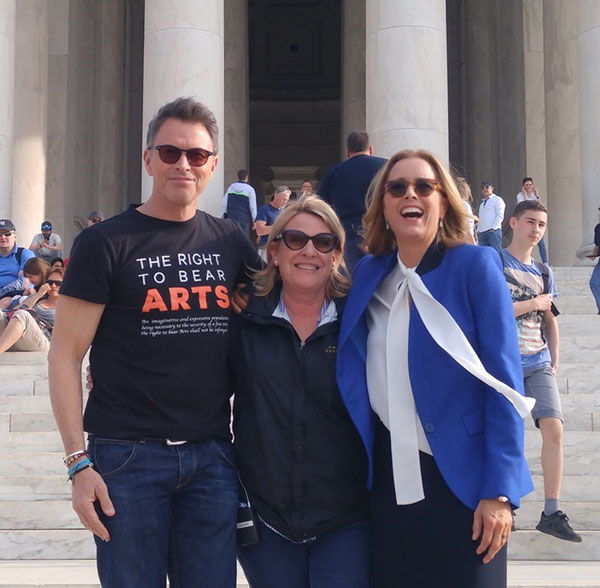 Madam Secretary creator Barbara Hall with actors Tim Daly and Téa Leoni.
Hall set the series a term in the future, so that it wouldn’t intersect with real issues. “But we were living in such times that we couldn’t avoid it eventually.” In season 3, the show addressed climate change. “But we did it by coming through the Defense Department. They had to write up reports about rising sea levels because they had to constantly rebuild bases all around the world.” In season 5, “We took on the family separation issue, because it was just so aggressive and everywhere and impossible to ignore.”
In the final season, McCord was elected president, and was almost impeached thanks to deep fakes. “I was hearing so much vitriol against Hillary Clinton from the Republican side,” Hall says. “I thought, if she gets elected, they’re going to pull out all the stops, so I wanted to put our first female president through that kind of challenge.”
Years earlier, Rod Davis Lurie wrote the film The Contender, about a female vice-presidential candidate, with a similar intent. After watching George W. Bush announce his candidacy, Lurie’s young daughter asked why girls never ran. “She declared right then and there that she was going to be the first woman president,” Lurie said. “I knew what I had to write. The Contender was about the difficulties that women will encounter when trying to assume positions of power, and the misogyny that will always be there.”

The time is ripe for a West Wing reboot, which is something I actually said to Aaron Sorkin recently. Current events would make the show even more of a tonic than it was in its heyday.
- Eli Attie
Lurie’s historical film Lucky Strike, a World War II movie about the Battle of the Bulge, is out now. “Unambiguous virtue is something we really seek right now, even if it means a bit of pedestrianism in our filmmaking,” he says.
He adds that those earlier projects seem idealistic today. “And the villains are people that right now would be aspirational characters, almost. There’s no greater villain you can create in American politics than Donald Trump, in your wildest imagination. And you can’t create bigger corruption, it’s so blatant. There’s literally nothing you can parody anymore.”
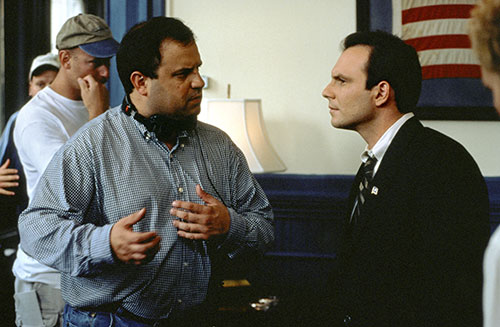 Rod Lurie with Christian Slater the set of The Contender. Photo by Gino Mifsud/Dreamworks.
At least not in a traditional series format. “Thank god for South Park and shows that can turn around a story within a week,” says Alex Gregory, who was an EP on Veep (Created by Armando Iannucci). “That’s why late-night shows and Saturday Night Live are so valuable, because you can respond in the moment to something that’s happening.”
Conversely, fantasy storylines that reflect on current events can be more powerful than those set in our reality, he suggests, and praises the sci-fi series Andor (Created by Tony Gilroy) for its powerful depiction of how dehumanizing oppression is—for both the oppressors and the revolutionaries. “I would also argue that Andor might be as much about the Russian Revolution of 1917 as it was about what’s going on now. It was done in a timeless manner, which allows you some distance between what you’re watching and what you’re feeling.”
The savage political satire Veep was very of the moment, until the moment lapped it. Iannucci never revealed Vice President Selina Meyer’s political affiliation, which made space for both sides of the aisle to enjoy it. But once Donald Trump was in office, then-showrunner David Mandel realized it was impossible to satirize the White House, because reality was so much more absurd. Attie remembers visiting Mandel and the writers in their offices; “they were literally ripping up scripts.” After seven seasons, the series ended in 2019.
After Veep, Gregory and Peter Huyck co-created White House Plumbers, which initially set out to explore the cost of extremism on the families of extremists. “Then January 6 happened, and it added a whole new element onto it,” Gregory says. “History caught up with us, and then it became this weird parallel.”
He adds, “I find comfort in history, so I would find something like White House Plumbers and its Nixonian bumblers reassuring. ‘Oh, we’ve been here before, we made it through, we still have a country.’ I’m sure people at the time thought America was coming to an end.”
 Rick Cleveland
Cleveland grew up watching the Watergate hearings, “but what happened on January 6, that’s unlike anything that’s happened in my lifetime. Even George W. Bush seems almost quaint and cozy compared to Trump right now.”
He worked on House of Cards (Developed by Beau Willimon) a decade after The West Wing. “People were a little burned out after Obama’s first term played out and the Republicans shut down the government for the first time since the Clinton administration. The time was ripe for something a little more cynical.”
In fact, Attie says, “The time is ripe for a West Wing reboot, which is something I actually said to Aaron Sorkin recently. Current events would make the show even more of a tonic than it was in its heyday.”
Gregory agrees. “But it would be listed under fantasy or sci-fi, in the genre category.” He often hears that a show like Veep couldn’t be made today—even from other Veep writers. Gregory disagrees so heartily that he’s currently writing the pilot of a political show with a Veep colleague, “borne out of people saying you can’t do Veep now, and me saying well, maybe there’s a way to do something like it. Hopefully you’ll see it, and if not, I’ll blame it on the political situation.”